

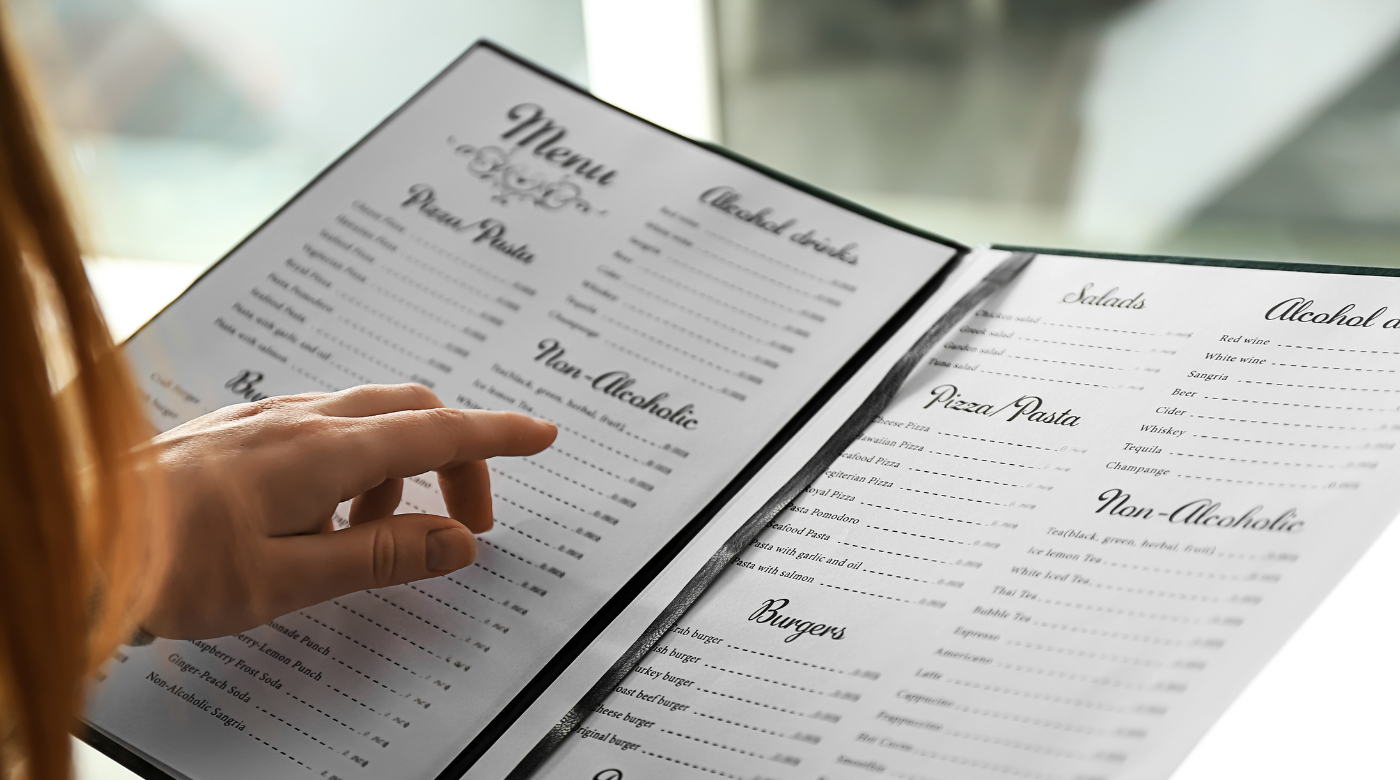
Most restaurants don’t fail because the food isn’t good. They fail because the numbers don’t work, and menu pricing is where that math either holds up or quietly falls apart.
Plenty of operators set prices by looking at what the restaurant down the street charges, adding a little, and hoping it covers costs. That approach can survive a good month. It doesn’t survive a bad quarter, a supplier price increase, or a slow season.
Pricing your menu properly means knowing exactly what each dish costs you to produce, understanding what your concept and market will support, and building in the margin that keeps your doors open. This guide covers the formulas, the strategies layered on top of them, and the costing mistakes that quietly erode profit on menus that look fine on paper.
1. Start With Your Plate Cost
Every pricing decision starts with one number: what it costs you to put a single serving of a dish in front of a customer.
Plate cost (also called cost per serving) is the total cost of every ingredient in one portion. That means everything, not just the protein and the sides.
To calculate plate cost:
- List every ingredient in the dish, including oils, seasonings, garnishes, and condiments
- Determine the cost per unit for each ingredient based on what you actually pay your supplier
- Calculate the cost of the exact quantity used in one serving
- Add them together
Worked example for a grilled chicken sandwich:
- 6 oz chicken breast: $1.85
- Brioche bun: $0.55
- 2 slices provolone: $0.40
- Lettuce, tomato, onion: $0.30
- Aioli (1 tbsp): $0.12
- Pickle spear: $0.10
- Cooking oil and seasoning: $0.08
- 5 oz fries: $0.45
Total plate cost: $3.85
Two things determine whether this number stays accurate: portion consistency and yield. If your line cooks are eyeballing portions, your real plate cost drifts above your calculated one. And if you’re costing raw weight without accounting for trim loss and cooking shrink, you’re understating your cost on every protein you serve.
Use standardized recipes with specified quantities, and cost your proteins based on usable yield rather than purchase weight.
2. Understand Food Cost Percentage
Food cost percentage is the share of your revenue that goes toward the food itself. It’s the benchmark that tells you whether your pricing leaves enough room for everything else.
Is 30% a typical food cost?
Yes, 30% sits right in the middle of the standard range. Most restaurants operate with food costs between 28% and 35% of menu price. Where you land within that range depends on your concept:
- Quick service and fast casual: 25–30% — lower food cost offsets thinner ticket averages and high volume
- Casual dining: 28–33% — the industry midpoint
- Fine dining: 30–38% — premium ingredients push food cost higher, offset by higher labor and price points
- Pizza and beverage-heavy concepts: 20–28% — high-margin categories pull the average down
Calculating your actual food cost percentage:
Over a set period — a week or a month — use this formula:
Food Cost % = (Beginning Inventory + Purchases − Ending Inventory) ÷ Food Sales
Example:
- Beginning inventory: $11,000
- Purchases: $7,000
- Ending inventory: $9,500
- Food sales: $26,000
($11,000 + $7,000 − $9,500) ÷ $26,000 = 32.7%
Your ideal food cost percentage is the target you’re pricing toward. Your actual is what’s really happening. The gap between them is where waste, over-portioning, theft, and un-updated costs are hiding, and closing that gap is often more profitable than raising prices.
3. Calculate Your Menu Price
Once you know your plate cost and your target food cost percentage, the pricing math is straightforward. There are two standard formulas, and they arrive at the same place from different directions.
Method 1: Food Cost Percentage
Menu Price = Plate Cost ÷ Ideal Food Cost Percentage
Using our chicken sandwich at $3.85 plate cost with a 30% target:
$3.85 ÷ 0.30 = $12.83
Round to a clean number: $12.95
Method 2: Gross Profit Margin
Some operators prefer to work from the margin they want to earn rather than the cost percentage they want to hit.
Gross Profit Margin = (Menu Price − Plate Cost) ÷ Menu Price
If you want a 70% gross margin on the same sandwich:
$3.85 ÷ (1 − 0.70) = $12.83
Same answer — the two methods are mathematically equivalent. Food cost percentage is more common in kitchens; gross margin is more common in financial reporting. Use whichever your team finds more intuitive, but be consistent across the menu.
Checking your existing prices
To evaluate a price you’ve already set, run it backward:
A dish priced at $16.00 with a $5.60 plate cost has a food cost of 35% and a gross margin of 65%. Run this across your full menu and you’ll quickly see which items are carrying the operation and which are dragging it down.
4. Factor In Labor and Prime Cost
Food cost percentage is useful, but it’s incomplete. Two dishes with identical plate costs can have very different profitability if one takes four minutes to plate and the other takes twenty.
Prime cost: your cost of goods sold plus total labor is the number that determines whether your restaurant is viable.
Prime Cost = COGS + Total Labor Cost
Most successful full-service restaurants keep prime cost at or below 60–65% of total revenue. Quick service concepts often target closer to 55–60%. If your prime cost is running above 70%, no amount of sales volume will fix the underlying math.
What this means for individual menu items:
- Labor-intensive dishes: house-made pasta, braised proteins, elaborate plating — need higher margins to justify the kitchen time they consume
- Assembly-driven items: salads, sandwiches, pre-portioned proteins — can support slightly higher food cost percentages because they demand less labor
- Batch-prepped items: soups, sauces, braises made in volume — spread labor across many servings and are often your most profitable menu positions
When you’re deciding which items to push, promote, or feature on the menu, factor in labor intensity alongside food cost. The highest-margin item on paper isn’t always the most profitable in practice.
5. Restaurant Menu Pricing Strategies
The formulas give you a floor, but the strategy determines where above that floor you land.
Competitor-based pricing
Use local comparable restaurants as a reference point, then decide where you sit relative to them:
- Match their pricing when you’re competing primarily on brand, atmosphere, or service quality
- Price below when you’re positioned as the accessible, high-value option in your market
- Price above when your concept, sourcing, or experience justifies a premium — and make sure the experience delivers on it
The critical caveat: never price off competitors without knowing your own costs first. Their cost structure isn’t yours.
Demand-based pricing
When demand outstrips supply, prices can rise. Restaurants with a signature dish people specifically travel for, limited seating, or a captive location have room to charge more than the formula suggests.
Value-based pricing
Price according to what the dish is worth to the customer, not just what it costs you. A dish with a compelling story — heritage grain, local farm sourcing, a technique that takes three days — carries perceived value beyond its ingredients.
Charm pricing
Prices ending in 9 or 5 read as lower than they are. $12.95 lands differently than $13.00, even though the difference is a nickel. Casual and fast casual concepts use charm pricing heavily. Fine dining tends to avoid it — round numbers like $34 read as more confident and less promotional.
Customer expectations set your ceiling
Your concept, location, and clientele establish a range customers consider reasonable before they ever read your menu. A $19 burger works in some neighborhoods and stalls in others. Know your market’s tolerance and price within it. Or change the concept.
6. Use Menu Design to Support Your Pricing
How prices are presented affects what customers order. Menu engineering pairs your pricing math with layout decisions that guide diners toward your most profitable items.
- Place high-margin items where eyes land first: Diners typically scan the top and bottom of each section and gravitate toward the center and upper corners of the page. Put your best-performing items in those positions.
- Drop the dollar signs: Menus that list “14” instead of “$14.00” consistently see higher spend. The currency symbol makes cost more salient.
- Avoid price columns: A right-aligned column of prices invites customers to compare on cost and order from the bottom. Place prices directly after the item description instead.
- Use descriptive language: Detailed descriptions increase perceived value and order rates. “Slow-braised short rib with rosemary jus” earns its price better than “braised beef.”
- Highlight sparingly: Boxes, borders, and graphics draw the eye — but only if used on one or two items per section. Highlight everything and you’ve highlighted nothing.
- Keep sections short: Long lists push diners toward familiar defaults. Tighter sections make it easier to steer them toward what you want to sell.
7. Track and Adjust Your Prices
Menu pricing isn’t a one-time exercise. Ingredient costs shift, labor rates rise, and the price that worked last year may be eroding your margin today.
Monitor how price changes affect sales
After any price adjustment, watch item-level sales for four to six weeks. If volume drops sharply, you’ve crossed a threshold your customers weren’t willing to follow you past. If volume holds steady or grows, you likely had more room than you used.
Re-cost your recipes regularly
Review plate costs quarterly at minimum, and immediately when a key ingredient sees a significant price move. A menu costed eighteen months ago is a menu priced for a market that no longer exists.
Raise prices strategically, not across the board
A uniform 8% increase on every item is the bluntest tool available and the most likely to be noticed. Instead, raise prices on items with strong demand and low price sensitivity, leave your value anchors alone, and consider adjusting portion or presentation on items where a price increase would be poorly received.
Control costs before you raise prices
Raising prices is one lever. Lowering your cost of goods is the other — and it’s often the one customers never notice.
Reviewing your supply chain is the most direct path to a better food cost percentage without touching your menu. Buying core ingredients at wholesale pricing, consolidating purchasing to reduce per-unit costs, and eliminating minimum order requirements all improve your margins from the cost side. Shamrock Foodservice Warehouse carries proteins, produce, dairy, dry goods, and disposables at wholesale pricing with no membership fees across 15 locations in the Southwest. Find a store near you at shamrockfsw.com/locations.
8. Common Menu Pricing and Food Costing Mistakes
Most pricing problems trace back to the same handful of errors:
- Never costing recipes at all: Pricing by instinct or by competitor comparison without knowing your own plate costs means you don’t actually know which items make money.
- Ignoring yield and trim loss: Costing a protein at purchase weight rather than usable weight understates your true cost on every plate — often by 15–25% on items with significant trim.
- Forgetting the small stuff: Oil, seasoning, garnishes, condiments, and packaging add up. Individually they’re pennies; across thousands of covers they’re real money.
- Letting costs go stale: Ingredient prices move constantly. A recipe costed a year ago is a guess, not a number.
- Pricing off competitors alone: Their labor structure, rent, volume, and supplier terms are different from yours. Their price may not be sustainable for your operation.
- Ignoring labor intensity: Two items with the same food cost aren’t equally profitable if one ties up a cook for twenty minutes.
- Blanket price increases: Raising everything by the same percentage is the most visible and least strategic way to protect margin.
- Not tracking waste: Spoilage, over-portioning, and comps don’t show up in your ideal food cost — but they show up in your actual one.
Frequently Asked Questions
How do you calculate restaurant menu pricing?
Divide the plate cost of the dish by your target food cost percentage. A dish that costs $4.00 to produce, priced at a 30% food cost target, comes out to $13.33 — round to $13.50 or $12.95 depending on your pricing convention.
How do you calculate price per meal?
Add up the cost of every ingredient in one serving (including oils, seasonings, garnishes, and condiments) to get your plate cost. That’s your cost per meal. Divide it by your target food cost percentage to reach your menu price.
Is 30% a typical food cost?
Yes. Most restaurants run food costs between 28% and 35%, making 30% a common target. Quick service concepts often run lower at 25–30%, while fine dining frequently runs higher at 30–38% due to premium ingredients.
What are food pricing strategies?
The main approaches are cost-based pricing (building up from plate cost and target margin), competitor-based pricing (positioning relative to comparable restaurants), demand-based pricing (charging more when demand is strong or supply is limited), and value-based pricing (pricing to perceived worth). Most restaurants use cost-based pricing as the foundation and layer the others on top.
What is an example of a menu cost?
In economics, a “menu cost” refers to the expense a business incurs when changing its prices — literally named for restaurants reprinting menus. Examples include design and printing costs for new menus, updating digital menu boards, reprogramming your POS, and the indirect cost of customers reacting negatively to the increase. It’s a useful reminder that price changes carry their own expense, so they’re worth doing deliberately rather than frequently.
What are common food costing mistakes?
The most frequent are failing to cost recipes at all, ignoring yield and trim loss, omitting small-ticket ingredients like oil and garnishes, letting ingredient costs go un-updated, and pricing based on competitors without knowing your own numbers.
Protect Your Margins With Shamrock Foodservice Warehouse
Menu pricing is one half of the profitability equation. What you pay for ingredients is the other and it’s the half you can improve without asking a single customer to pay more.
Shamrock Foodservice Warehouse carries the products restaurants depend on: proteins, produce, dairy, dry goods, beverages, and disposables at wholesale pricing with no membership fees required. With 15 locations across Arizona, Colorado, Montana, New Mexico, and Texas, keeping your cost of goods predictable is straightforward wherever you’re operating in the Southwest.
Find your nearest location at shamrockfsw.com/locations.